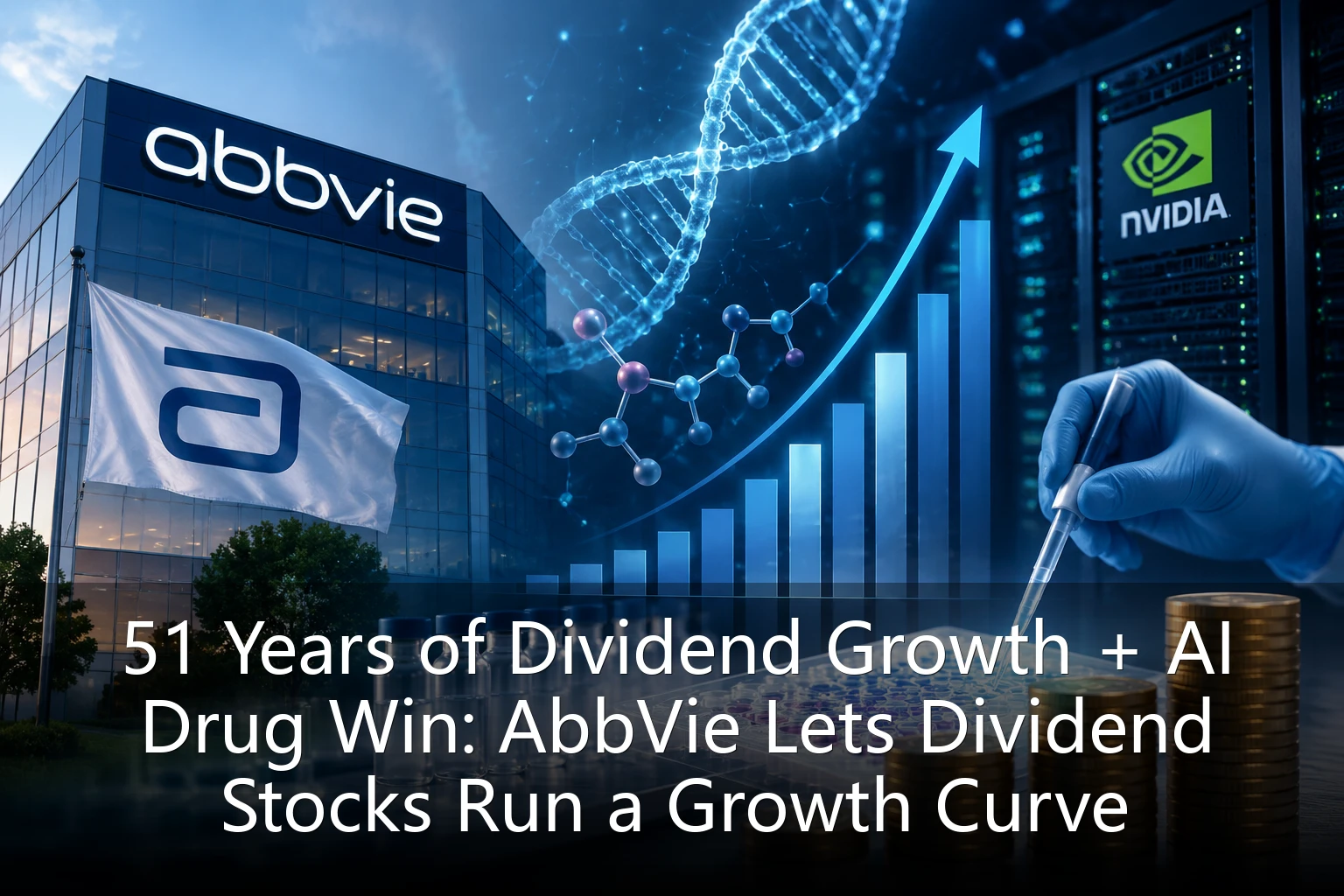
On August 1, 2026, AbbVie (ABBV) released two major announcements before market open: a 4.9% quarterly dividend increase to $1.70 per share, and its AI drug platform's PARP inhibitor met the primary progression-free survival (PFS) endpoint in a Phase III ovarian cancer trial. Shares rose as much as 3.2% after the news, leading the pharma sector.
A 51-Year "Dividend King" Advances Further
As the healthcare company with the longest consecutive dividend growth streak in the S&P 500, AbbVie has continued Abbott's dividend growth tradition since spinning off in 2013. After this increase, the annual dividend totals $6.80, implying a yield of about 3.6% at current prices—well above the S&P 500 average of 1.2%.
"We have a strong free cash flow engine, projected to generate $28 billion in operating cash in fiscal 2026, providing ample fuel for capital returns," said CEO Richard Gonzalez in a statement. In Q1 results, immunology products Skyrizi and Rinvoq together posted $8.9 billion in sales, up 12% year over year, partially offsetting Humira biosimilar erosion.
AI Creates a "Blockbuster" Molecule: PARP Inhibitor Data Beat Expectations
At the same R&D open house, AbbVie showcased the first result of its proprietary AI drug discovery platform "AIDD"—Veliparib. The drug is for maintenance treatment of BRCA-mutant ovarian cancer. Phase III data showed median PFS extended from 12.1 to 17.3 months versus placebo (HR=0.66, p<0.001). Notably, the molecule went from target validation to IND filing in just 27 months, versus an industry average of 42 months.
"AI dramatically lowers our error rate," said Chief Scientific Officer Thomas Hudson. The AIDD platform integrates Transformer architecture and reinforcement learning, generating millions of candidate compounds in days and performing virtual screening based on synthetic lethality. Five pipeline programs from this platform have advanced to clinical stages.
Compute Foundation: From Nvidia GPUs to Cloud-Native
AbbVie recently expanded its partnership with Nvidia, integrating the BioNeMo framework into its internal compute center. Its latest cluster uses 12,000 H200 GPUs for AlphaFold-like protein structure prediction. Compute spending is set to rise from $260 million in 2024 to $780 million in 2026, but the company expects every additional $1 in AI investment to save $3 in outsourced R&D costs over five years.
Evolution of Dividend Strategy: Defensive Assets Become Growth Stocks
For a long time, pharma dividend stocks were seen as low-volatility "bond-like" assets, but the AI revolution is changing market perception. JPMorgan analysts note that top pharma firms' AI drug success rates have risen from about 10% in 2018 to 19% in 2026—nearly double the industry average R&D success rate. This provides a second growth curve for traditional high-dividend companies.
- Safety margin: AbbVie's dividend coverage is 2.1x, well above the 1.5x warning line; its S&P credit rating is A-.
- AI efficiency: The company expects AI to shorten R&D timelines by 30% and save $2.5 billion annually by 2028.
- Pipeline depth: Beyond Veliparib, the AI platform is advancing an anti-Nectin-4 ADC, expected to enter Phase III by year-end.
Beware the "Innovation Dependency" Risk
Despite the bright outlook, skepticism about AI drug discovery persists. Barclays notes that patentability of AI-generated molecules and real-world evidence are still lacking, and competition in the GLP-1 space may distract management. AbbVie's obesity drug ABBV-101 showed 16.2% weight loss at 36 weeks in Phase I, below Lilly's tirzepatide at 22.5%. Data will be released in Q4 this year, which could hinder valuation upside.
Conclusion: A Cost-Effective Pick in Dividend Healthcare
AbbVie currently trades at a forward P/E of 15.2x, below Johnson & Johnson (15.8x) and Pfizer (16.5x), with a higher dividend yield than both. In a falling-rate cycle, its 3.6% yield plus AI-driven optionality makes "buy and wait" an attractive strategy. Of 23 Wall Street analysts, 18 rate it a Buy, with an average price target of $223.
For income-focused healthcare investors, AbbVie may offer a paradigm of "both dividends and growth." But always remember: drug failures and policy volatility remain black swans for pharma stocks.