
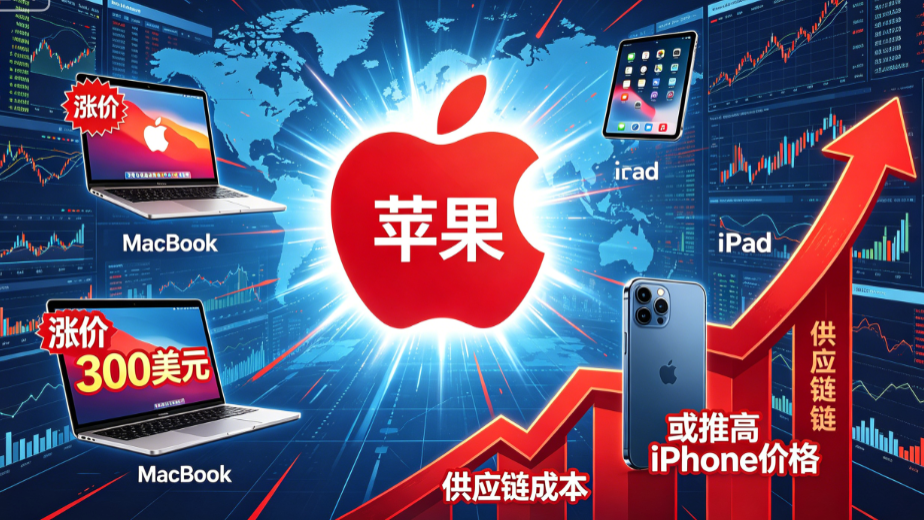
Apple Product Price Hike: MacBook and iPad Up to $300 Higher, iPhone Could Be Next
Keywords: Apple; Price Increase; MacBook; iPad; iPhone; Market Impact; Supply Chain
Introduction
Global tech giant Apple recently announced price increases for some of its core products, drawing widespread market attention. According to official information, prices for MacBook and iPad series have risen by up to $300 in several markets, and the industry generally expects iPhone series may follow suit. This decision not only directly affects consumer purchasing decisions but also reflects deep structural changes in the global electronics industry. This article systematically analyzes the specifics of the price increase, its underlying causes, impact on the market and consumers, and possible future evolution.
1. Specifics of the Price Increase: Multi-Product Line Synchronized Rise, Highest in Recent Years
This price adjustment covers Apple's most core product lines: MacBook and iPad. For example, the high-end MacBook Pro model saw price increases of up to $300 in some countries and regions, equivalent to about 2,100 RMB. The M2 chip-equipped MacBook Air also saw increases of $50 to $100. For iPads, both iPad Pro and iPad Air were affected, with increases generally ranging from $50 to $150, with the 12.9-inch iPad Pro experiencing the most significant rise.
Notably, this price increase is not globally uniform, showing clear regional differences. Markets in Europe, Japan, and Australia saw particularly pronounced increases, while the adjustment in the US domestic market was relatively moderate. This differentiated strategy indicates that Apple has made fine-tuned trade-offs between exchange rate fluctuations, local tax policies, and market competition environment.
2. Deep Analysis of Price Increase Drivers: Dual Drive of Cost Pass-Through and Strategic Adjustment
2.1 Continued Rise in Global Supply Chain Costs
From the supply side, procurement costs for core components such as semiconductor chips, panels, and metal casings have risen significantly over the past year. Affected by geopolitical conflicts, energy price volatility, and post-pandemic global logistics system adjustments, manufacturing and transport costs have both been pushed to historical highs. Although Apple has strong bargaining power in its supply chain, it cannot avoid systemic cost increases. Additionally, key foundries like TSMC recently raised wafer prices for advanced processes, directly increasing the manufacturing cost of M-series chips.
2.2 Exchange Rate Fluctuations Erode Overseas Profits
The continued strength of the US dollar is another key driver of this price increase. Since 2022, the dollar has fluctuated sharply against major currencies such as the yen, euro, and pound, causing Apple's revenue in non-dollar regions to shrink when converted to dollars. To maintain global profit margins, Apple has had to hedge exchange rate risks through local price adjustments. For example, in the Japanese market, the MacBook Air's increase exceeded 20%, closely matching the yen's depreciation against the dollar.
2.3 Product Positioning and Brand Premium Strategy
From a strategic perspective, Apple has been strengthening its high-end positioning by widening the price gap between Pro and entry-level series, guiding users toward higher-margin products. This price increase partly reflects Apple's confidence in its brand value – even with price hikes, core users may not leave. At the same time, the increase also helps reserve pricing space for future new products, forming a pricing ladder where "old models increase price → highlight new models' cost-effectiveness."
3. Market and Consumer Impact: Short-Term Pressure, Long-Term Structural Divergence
3.1 Consumer Purchase Intent May Be Dampened
For ordinary consumers, the current round of MacBook and iPad price increases has exceeded the natural price rise from routine annual updates. For example, a $300 increase may push education users, freelancers, and SME users toward lower-priced alternatives or delay upgrade plans. Market research firm IDC data shows that global PC shipments fell 13.4% year-on-year in Q2 2023, and tablet shipments fell 17.3%. Against this backdrop, price increases will undoubtedly further compress demand.
3.2 Ecosystem Lock-In Effect Offsets Some Negative Impact
However, Apple's ecosystem advantage cannot be underestimated. iCloud, App Store, Apple Music, and seamless device interconnectivity create high switching costs for users. For those deeply embedded in the Apple ecosystem, the price increase means more "endurance" than "departure." Therefore, in the short term, Apple's gross margin may improve, but shipment volumes may face pressure.
3.3 Second-Hand Market and Alternatives Seize Opportunities
The price hike positively boosts the second-hand market and third-party repair industry. More users may choose to buy refurbished devices or extend the life of existing devices. At the same time, Android and Windows camp leaders like Samsung, Lenovo, and Microsoft are seizing the opportunity to promote their cost-effectiveness, trying to grab market share from Apple.
4. Possibility and Potential Impact of iPhone Following Price Increase
Although Apple has not officially announced an iPhone price increase, industry analysis widely believes the iPhone 15 series could be the next flagship to see a hike. If an iPhone price increase occurs, its impact will far exceed that of MacBook and iPad, as iPhone accounts for over 50% of Apple's total revenue and covers a broader consumer base.
4.1 Sources of Price Increase Pressure
iPhone faces the same cost increase issues, especially with the A17 chip using 3nm process, whose per-chip cost is expected to increase by over 30% compared to the previous generation. Additionally, new configurations like titanium frame and periscope lens will drive up BOM (bill of materials) costs. If Apple chooses to maintain profit margins, a price increase is almost inevitable.
4.2 Market Risks and Response Strategies
The biggest risk of an iPhone price increase is a decline in sales, especially in emerging markets. Apple may adopt a differentiated strategy of "significant increase for Pro series, slight adjustment for standard version," and strengthen financial tools like trade-ins and installment plans to smooth consumer burden. At the same time, relying on continued growth in software service revenue to offset hardware profit fluctuations has long been Apple's consistent approach.
Conclusion
The price increase of up to $300 for MacBook and iPad marks Apple's formal entry into a round of proactive or forced price adjustment cycles. Behind this decision lies a combination of global inflationary pressure, supply chain cost increases, sharp exchange rate fluctuations, and its own high-end strategy. For consumers, it is recommended to rationally assess their needs and budget, and watch official refurbished channels and trade-in policies. For investors, Apple's short-term profit margins are likely to remain strong, but caution is needed regarding downside risk in shipment volumes due to slowing demand. Whether the iPhone can weather the price increase impact will depend on Apple's ability to balance technological innovation, ecosystem stickiness, and pricing artistry. A more expensive Apple is reshaping the competitive landscape of the global consumer electronics market.


