
Global Currency Game: USD Under Pressure, RMB Steady, and Policy Trade-offs Under Yen Rate Hike Pressure
Keywords
USD Index, RMB Exchange Rate, Yen Monetary Policy, Forex Market, Global Finance
Introduction
Against the backdrop of uneven global economic recovery and intensified divergence in major central bank policies, the foreign exchange market is experiencing a new round of violent fluctuations. Recently, the USD index has continued to come under pressure, while the RMB central parity rate against the USD stood at 6.8066, showing the Chinese central bank's policy intent to maintain basic exchange rate stability under external pressure. At the same time, the USD/JPY exchange rate is approaching the key 162 level, and Japan's central bank officials have frequently spoken out, emphasizing the need to raise interest rates to a neutral level to cope with imported inflation and economic imbalances caused by the sustained depreciation of the yen. This series of dynamics reflects the policy dilemmas and game logic of major economies under the greenhouse effect. This article will conduct an in-depth analysis from three dimensions: the trend of the US dollar, the management of the RMB exchange rate, and the pressure of yen depreciation, exploring the deep causes and future direction of the current global monetary pattern.
USD Index Under Pressure: Global Economic Slowdown and Policy Shift
The USD index has been declining recently, driven by multiple factors. First, signs of weakening US economic growth momentum are becoming increasingly evident: manufacturing PMI has been below the boom-bust line, consumer confidence index has fallen, and the real estate market is cooling, all of which have weakened the market's safe-haven demand for the dollar. Second, expectations that the Fed's rate hike cycle is nearing its end are strengthening. Although inflation stickiness remains, the effects of labor market cooling and credit tightening are gradually emerging, and market bets on the Fed cutting rates within the year continue to heat up, as seen in the pricing of interest rate futures.
Additionally, the recurring US government debt ceiling issue has exacerbated market concerns about dollar credit. Although an agreement was eventually reached, the frequent political games have implicitly eroded the dollar's reserve currency status. From an international capital flow perspective, funds are shifting from dollar assets to other currencies such as the euro and yen, further pressuring the dollar index.
It is worth noting that the USD weakening is not driven by a single factor, but an inevitable result of the restructuring of the global economy. The resilient recovery of emerging economies, especially China, and policy adjustments in economies such as Europe and Japan are reshaping the global exchange rate pricing mechanism. The pressure on the USD index is superficially a reaction to short-term market sentiment, but at a deeper level reflects the long-term logic of the multi-polar trend challenging the unilateral hegemony of the dollar.
RMB Central Parity Rate at 6.8066: Stability as the Priority
While the dollar weakens, the Chinese central bank announced the RMB central parity rate against the dollar at 6.8066, slightly higher than the previous trading day. This pricing arrangement reflects the central bank's policy thinking of "focusing on itself and prioritizing stability." From a macro perspective, the relative stability of the RMB exchange rate is conducive to stabilizing market expectations and controlling imported inflation pressures, creating a favorable environment for domestic economic recovery.
Currently, China's foreign trade surplus remains high, capital account opening proceeds orderly, and the scale of foreign exchange reserves remains stable above $3 trillion, providing solid support for the RMB exchange rate. At the same time, the Chinese central bank has effectively prevented exchange rate overshooting risks by introducing counter-cyclical factors, adjusting foreign exchange deposit reserve ratios, and strengthening macro-prudential management of cross-border capital flows. Compared to the sharp fluctuations of currencies like the yen and euro against the dollar, the RMB exchange rate has shown stronger resilience.
However, external uncertainties still exist. Variables such as rising global trade protectionism, ongoing geopolitical conflicts, and the continuation of overseas rate hike cycles may have an impact on the RMB exchange rate. In the future, the Chinese central bank still needs to seek a dynamic balance between exchange rate flexibility and stability, preventing both excessive appreciation from affecting export competitiveness and depreciation expectations from self-reinforcing and causing capital outflows.
USD/JPY Approaching 162: Yen Depreciation and Rate Hike Pressure
If the RMB exchange rate embodies "stability," then the yen exchange rate shows a state of "danger." The USD/JPY approaching 162 means the yen has depreciated to its lowest level in 30 years. This is not only an extreme manifestation of market sentiment but also exposes the deep structural difficulties of the Japanese economy.
The direct consequence of yen depreciation is a sharp rise in the cost of imported energy and raw materials, pushing up corporate production costs and living costs for residents. For Japan, which relies heavily on energy imports, imported inflation puts the central bank in a dilemma between "stabilizing prices" and "stimulating the economy." Previously, the Bank of Japan adhered to ultra-loose monetary policy, trying to promote wage increases and consumption expansion by maintaining low interest rates, but with limited effect. On the contrary, continued yen depreciation has exacerbated capital outflows and imported inflation, putting the economy at risk of "stagflation."
Against this backdrop, Japanese central bank officials have recently frequently emphasized that interest rates must be raised to a neutral level to cope with systemic risks brought by exchange rate fluctuations. The so-called neutral rate is the interest rate level that neither stimulates nor suppresses economic growth. Currently, the BOJ's short-term policy rate remains at -0.1%, far below the estimated neutral rate range (about 0.5%-1.5%). This means the BOJ may adopt gradual rate hikes in the future to ease yen depreciation pressure and guide market expectations.
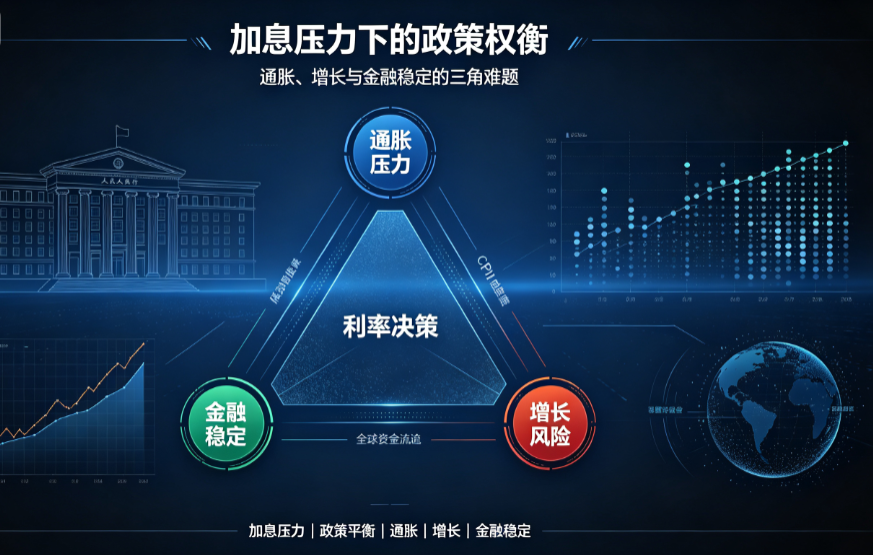
However, rate hikes are not without cost. Too rapid rate increases may dampen household consumption and corporate investment, leading to a premature end to economic recovery. Additionally, Japan's government debt accounts for over 260% of GDP, and rate hikes would significantly increase government interest payments, raising concerns about fiscal sustainability. Therefore, the BOJ needs to walk a tightrope among controlling exchange rate depreciation, stabilizing prices, and maintaining economic growth.
Policy Trade-offs and Games in Global Monetary Policy
From a broader perspective, the current game among major global currency systems is essentially a reflection of central banks' policy trade-offs between "stabilizing growth" and "fighting inflation." The Fed is at the end of its rate hike cycle but has not yet turned, the ECB's rate hikes are unabated, the BOJ faces pressure to shift, and the Chinese central bank maintains moderate easing. This policy divergence leads to more uncertain global capital flows and significantly increased exchange rate volatility risk.
For emerging markets and developing countries, the imported pressure from USD weakening and yen depreciation cannot be ignored. On one hand, a weaker dollar helps ease emerging markets' external debt repayment pressure; on the other hand, yen depreciation may intensify competitive devaluation in Asia, transmitting to other economies through trade channels. Moreover, the fragmentation trend of the global monetary system is accelerating, and the internationalization process of multi-polar currencies such as the yuan, ruble, and Indian rupee is gradually weakening the traditional dominance of the dollar and yen.
Conclusion
In summary, the USD index under pressure, RMB remaining stable, and yen encountering a depreciation crisis collectively form a three-fold picture of the current global monetary landscape. This pattern reflects differences in economic fundamentals among countries as well as profound divergence in monetary policy orientation. For investors and companies, exchange rate fluctuations bring both risks and opportunities, requiring close attention to central bank policy signals, global macroeconomic trends, and geopolitical risk changes. In the future, with the BOJ shifting to rate hikes, China's economy recovering steadily, and the global trade landscape restructuring, the global monetary system will enter a new equilibrium period. In this process, only policymakers with forward-looking vision and flexible tools can seize the initiative in the complex game.


