
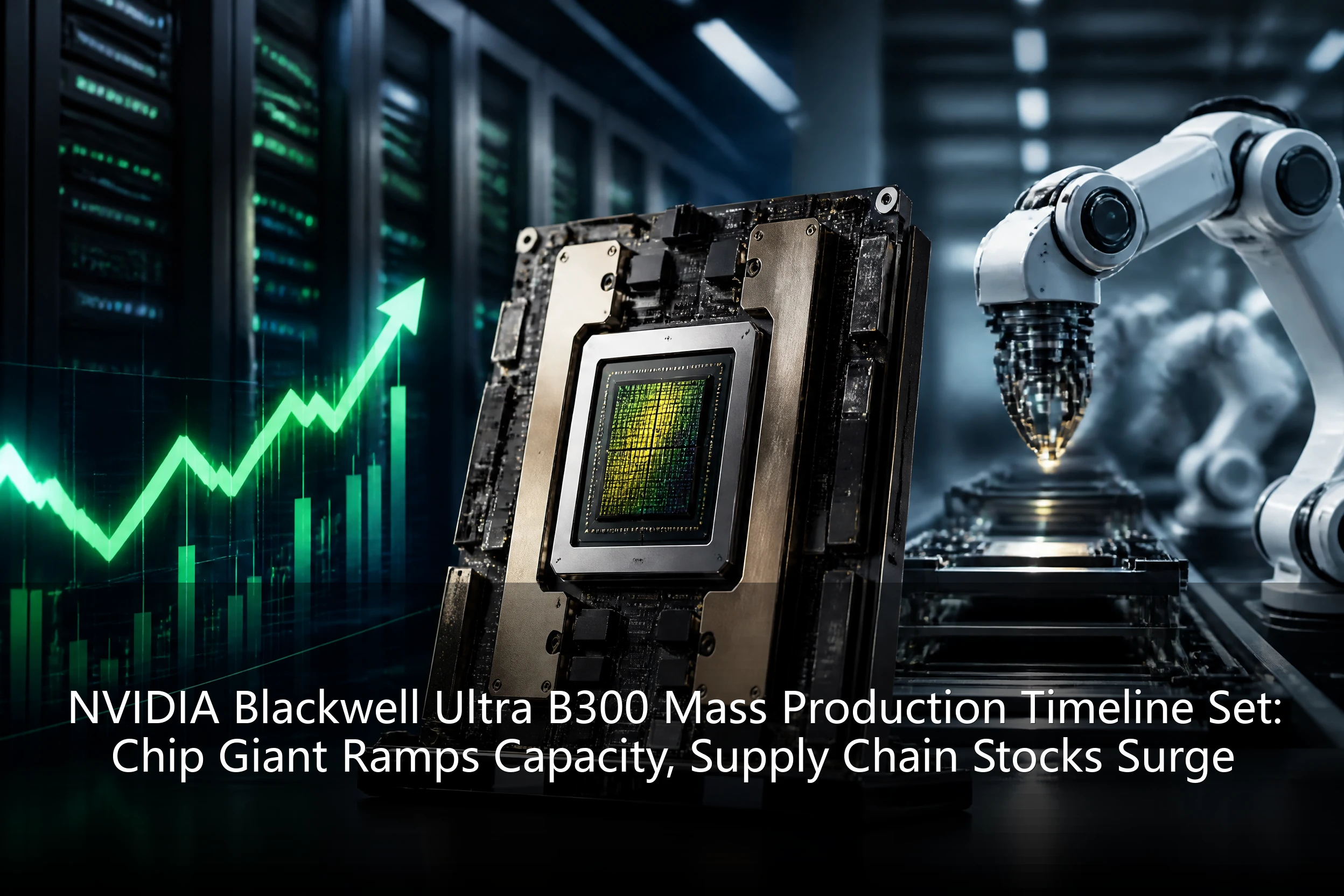
NVIDIA Blackwell Ultra Production Timeline Confirmed: A New Era of Computing Begins
On August 4, 2026, heavyweight news emerged in the US pre-market. According to multiple core suppliers in the semiconductor industry chain, NVIDIA's B300 series GPU, based on the Blackwell Ultra architecture, has largely completed engineering validation testing and is scheduled to officially begin mass production in Q4 2026. This timeline is ahead of the market's previous general expectation of early 2027, demonstrating NVIDIA's faster-than-expected progress in advanced packaging (CoWoS-L) and TSMC 3nm capacity allocation.
Following the announcement, US stock pre-market futures reacted swiftly. AI server customization leader Supermicro (SMCI) rose over 5% pre-market, Dell Technologies (DELL) gained over 3%, and shares of optical module supplier Coherent (COHR) and thermal solution provider Vertiv (VRT) saw notable movement. This signals that the computing power market is shifting from vague expectations for 'next-gen products' to a phase driven by tangible performance from 'mass production and procurement.'
Architectural Leap: From Hopper to Blackwell Ultra
As an enhanced version of the Blackwell architecture, Blackwell Ultra's core value lies in its extreme optimization for training and inference of trillion-parameter large language models. Compared to the current mainstream H100/H200 (Hopper architecture), the B300 series achieves a generational leap in the following dimensions:
- Memory Bandwidth and Capacity: The B300 will feature 12-layer stacked HBM3e memory, with total capacity expected to reach 288GB and bandwidth potentially exceeding 8TB/s, completely breaking the memory bottleneck for long-context inference in large models.
- NVLink Interconnect: A new NVLink Switch chip will achieve up to 1800GB/s of GPU-to-GPU interconnect bandwidth, making a single NVLink domain of 72 GPUs a reality and significantly reducing communication latency for tensor parallelism in large models.
- Energy Efficiency Optimization: Although single-card power consumption may climb to 1200W, the computing power output per watt at FP8 precision is nearly 3 times higher than the H200, addressing a major pain point for data center operators constrained by power limitations.
Supply Chain 'Arms Race' Restarts: Who Will Benefit?
With the B300 mass production timeline confirmed, the US AI computing power supply chain has entered a new capital expenditure cycle. Unlike the 'chip shortage' logic from 2023 to 2025, the investment focus in the B300 era is shifting towards 'system-level delivery capability' and 'supporting thermal management and interconnect.'
First, competition among AI server OEMs is intensifying. The B300's extremely high power density imposes stringent requirements on server rack design. Supermicro, with its Direct Liquid Cooling (DLC) solutions and modular rack design, has already secured significant initial orders from major cloud service providers. Dell Technologies, leveraging its strong global delivery network, is showing strong momentum in enterprise-level private deployment.
Second, demand for optical modules and copper cable connectors is being redefined. Due to the surge in internal data throughput within B300 clusters, the penetration rate of 800G and 1.6T optical modules will be forced to accelerate. Simultaneously, the demand for high-speed copper backplane connections inside the NVIDIA GB300 NVL72 rack extends the earnings visibility for related suppliers like Amphenol through 2027.
Finally, power infrastructure and cooling become the 'hidden champions.' A fully loaded B300 rack could consume up to 120kW, rendering air cooling completely obsolete and making liquid cooling a standard requirement. Companies like Vertiv, which offer full-stack power and thermal management solutions, are increasingly becoming a core bottleneck in AI data center construction.
Market Dynamics: Balancing Valuation Digestion and Capital Expenditure
While the B300 mass production news is a significant positive, investors must remain cautious about the high valuation pressure in the current US AI computing power sector. NVIDIA's forward price-to-earnings ratio (Forward PE) remains around 30x, indicating the market has fully priced in its growth expectations. True opportunities for exceeding expectations may lie more in 'secondary supply chain' segments that are not yet fully valued.
Furthermore, the market is closely watching the upcoming Q2 2026 earnings reports and second-half capital expenditure guidance from tech giants like Microsoft, Google, and Meta. If cloud service providers' capital expenditure growth shows marginal slowdown, even the B300's superior performance might face short-term inventory digestion pressure. However, based on current industry research feedback, to avoid falling behind in the generative AI race, tech giants' pursuit of the most advanced computing power remains at a 'cost-no-object' stage.
In summary, the confirmed mass production timeline for NVIDIA's Blackwell Ultra B300 injects the strongest catalyst into the US AI computing power sector for the second half of 2026. In an era where 'computing power is national power,' the new AI infrastructure supply chain built around the B300 will be a core investment theme that cannot be ignored over the next 12 months.


