
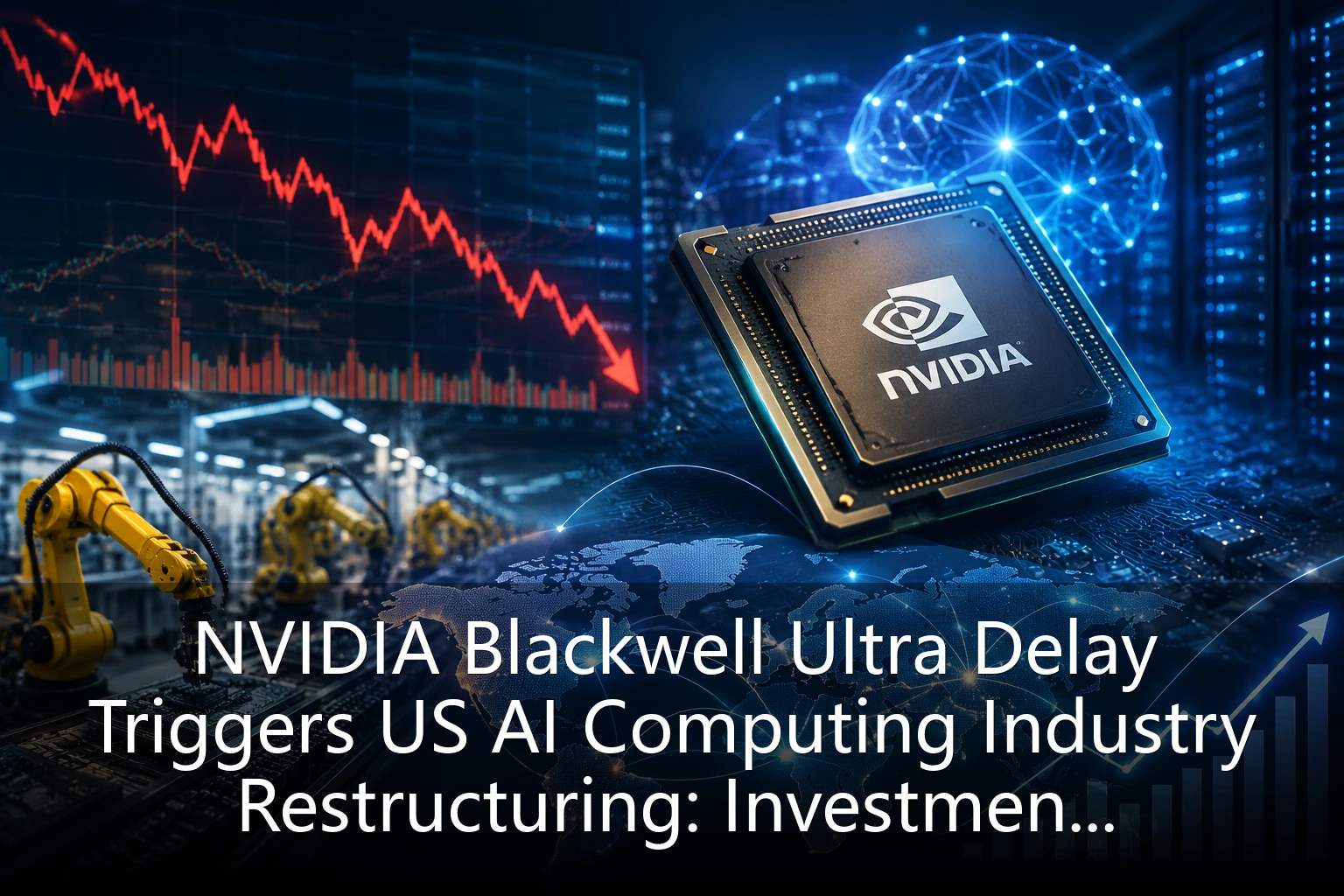
NVIDIA Blackwell Ultra Delay Triggers US AI Computing Industry Restructuring: Investment Opportunities and Risks Coexist
\n\nIn early August 2026, the global AI computing market was stirred. NVIDIA set the production timeline for its next-generation Blackwell Ultra B300 chip, but market reactions were polarized. On one hand, investors maintained confidence in NVIDIA's continued technological leadership; on the other hand, supply chain delay rumors raised concerns about the AI computing industry chain. This event not only reflects the complex dynamics of the current AI computing market but also reveals the structural challenges and opportunities facing the industry.
\n\nBlackwell Ultra Delay: Market Response and Short-term Impact
\n\nAccording to several industry analysts, the mass production of NVIDIA's Blackwell Ultra B300 chip will be delayed by about 2-3 months from the original schedule. After this news broke, NVIDIA's stock showed significant fluctuations in after-hours trading, while related supply chain companies' stock prices diverged. NVIDIA's official response stated that the delay was mainly due to "the need for process optimization and yield improvement," emphasizing that it was "to ensure the product meets the highest quality standards."
\n\nMarket analysts point out that the Blackwell Ultra B300, as NVIDIA's next-generation flagship AI chip, offers about 30% better performance and 25% improved energy efficiency compared to the previous Blackwell generation. Although the delay may affect some customers' deployment plans in the short term, the improved technical maturity will help consolidate NVIDIA's leading position in the high-end AI chip market in the long run.
\n\n"This delay actually reflects the challenges brought by the accelerating iteration speed of AI chip technology," said Sarah Johnson, technology industry analyst at Morgan Stanley. "When chip complexity grows exponentially, quality control becomes more difficult, but this precisely demonstrates the intense competition in the AI computing market."
\n\nRecent Dynamics and Structural Changes in the AI Computing Industry Chain
\n\nThe Blackwell Ultra delay event is not an isolated phenomenon but a microcosm of the current structural adjustment in the AI computing industry chain. Since the beginning of this year, the US AI computing market has shown several significant trends:
\n\n- \n
- Diversified Computing Demand: Expanding from traditional training needs to inference needs. IDC's latest report predicts that the global AI inference server market will grow by 45% in 2026, exceeding the growth rate of the training market. \n
- Regionalization of Supply Chain: Geopolitical factors are driving major tech companies to build diversified supply chains, reducing dependence on single regions. \n
- Accelerated Vertical Integration: The trend of vertical integration from chip design and manufacturing to data center operations is evident to optimize overall computing efficiency. \n
- Energy Efficiency Becomes Key Metric: While computing demand surges, energy efficiency has become an important standard for measuring AI chip performance. \n
These changes are reshaping the competitive landscape of the AI computing industry chain. Wall Street analysts generally believe that companies that can quickly adapt to these changes and establish advantages in key links will stand out in future competition.
\n\nAI Capital Expenditure Adjustments and Strategic Shifts by Tech Giants
\n\nThe Blackwell Ultra delay has also prompted major tech giants to re-examine their AI capital expenditure strategies. Recent financial reports from several tech companies show that AI-related capital expenditures are shifting from simply "pursuing quantity" to "pursuing efficiency and diversity."
\n\nIn its latest financial report, Google's parent company Alphabet announced that it will continue to expand the deployment scale of its TPU chip "Ironwood," which has 90% lower costs for inference tasks than the previous generation. Google CEO Sundar Pichai emphasized, "We will continue to invest in AI infrastructure, but with greater focus on energy efficiency and total cost of ownership."
\n\nMicrosoft, meanwhile, announced signing a 20-year power purchase agreement with a nuclear energy supplier to provide stable power for its AI data centers. This move reflects the energy bottleneck facing AI computing expansion. Microsoft CFO Amy Hood stated, "Energy costs have become a key consideration in AI deployment, and we need to ensure long-term, stable energy supply."
\n\nAmazon AWS has taken a different approach, reducing dependence on third-party chips through self-developed Trainium and Inferentia chips. AWS CEO Adam Selipsky said, "Self-developed chips allow us to better optimize the matching between cloud services and AI workloads, providing more cost-effective solutions."
\n\nSkyrocketing Computing Rental Prices: New Market Supply and Demand Landscape
\n\nDespite facing chip supply challenges, the AI computing rental market has shown unusually active momentum. The latest data shows that H200 computing rental prices have increased by 25% in the past three months, with the supply-demand imbalance becoming increasingly evident.
\n\n"Inference demand is taking over training demand to become the new engine of the computing market," said Michael Chen, analyst at market research firm TrendForce. "Enterprise AI applications are transitioning from experimental to production stages, causing a sharp increase in demand for inference computing, while the supply side has not yet fully kept up with this change."
\n\nThis trend has led to the emergence of new computing rental models. Platforms like CoreWeave are providing flexible computing rental solutions for customers by establishing long-term partnerships with chip manufacturers. CoreWeave's valuation has reached tens of billions of dollars, and its successful model is attracting more investor attention.
\n\n"The rise of the computing rental market reflects changes in enterprise demand for AI computing," said Emma Rodriguez, Wall Street hedge fund analyst. "Enterprises no longer pursue owning all computing resources but prefer to rent on demand, which can significantly reduce initial investment costs and improve resource utilization efficiency."
\n\nAI Computing Investment: Opportunities and Risks Coexist
\n\nFacing the complex dynamics of the AI computing market, investors need to adopt more cautious and diversified strategies. Here are some key investment considerations:
\n\n- \n
- Focus on Technology-leading Companies: Although NVIDIA faces short-term challenges, its technological leadership advantage remains significant, and its long-term investment value is worth attention. \n
- Layout Computing Infrastructure: Infrastructure providers including data centers, cooling systems, and energy solutions will benefit from AI computing expansion. \n
- Focus on Vertically Integrated Companies: Full-industry chain companies from chip design to cloud services have stronger risk resistance and cost advantages. \n
- Diversify Investment Risks: The AI computing industry chain involves multiple links, and investors should consider diversified allocation across different links. \n
"The AI computing market is in a transition period from 'quantity' to 'quality,'" said David Wilson, technology strategy analyst at Goldman Sachs. "Investors need to pay more attention to companies' technical barriers, cost control capabilities, and long-term strategic planning, rather than just focusing on short-term performance."
\n\nFuture Outlook: Long-term Development Trends of the AI Computing Market
\n\nDespite facing challenges in the short term, the long-term growth prospects of the AI computing market remain broad. According to predictions from multiple market research institutions, by 2030, the global AI computing market size will exceed $1 trillion, with a compound annual growth rate maintained at over 30%.
\n\nIn the coming years, the AI computing market may show several development trends:
\n\n- \n
- Rise of Specialized Chips: Specialized chips for specific AI application scenarios will receive more attention, with general AI chips and specialized chips developing side by side. \n
- Popularization of Edge Computing: As AI applications expand to edge devices, edge computing chips and solutions will become new growth points. \n
- Fusion of Quantum Computing and AI: The combination of quantum computing and AI may bring exponential improvements in computing power, but this field is still in its early stages. \n
- Green AI Computing: Energy efficiency and sustainable development will become important considerations for AI computing development, promoting innovation in green AI technologies. \n
The NVIDIA Blackwell Ultra delay event may be a turning point for the AI computing market from frenzy to maturity. As a senior investor put it, "AI computing is not a sprint but a marathon. Those companies that can adapt to changes, continue to innovate, and maintain financial health will ultimately win in this wave of technological change."
\n\nFor investors, understanding the complex dynamics of the AI computing market, grasping technology evolution trends, and adopting long-term, diversified investment strategies will be key to seizing investment opportunities in this field. As the AI revolution continues to deepen, computing power, as the infrastructure for AI development, will become increasingly prominent in investment value over time.


