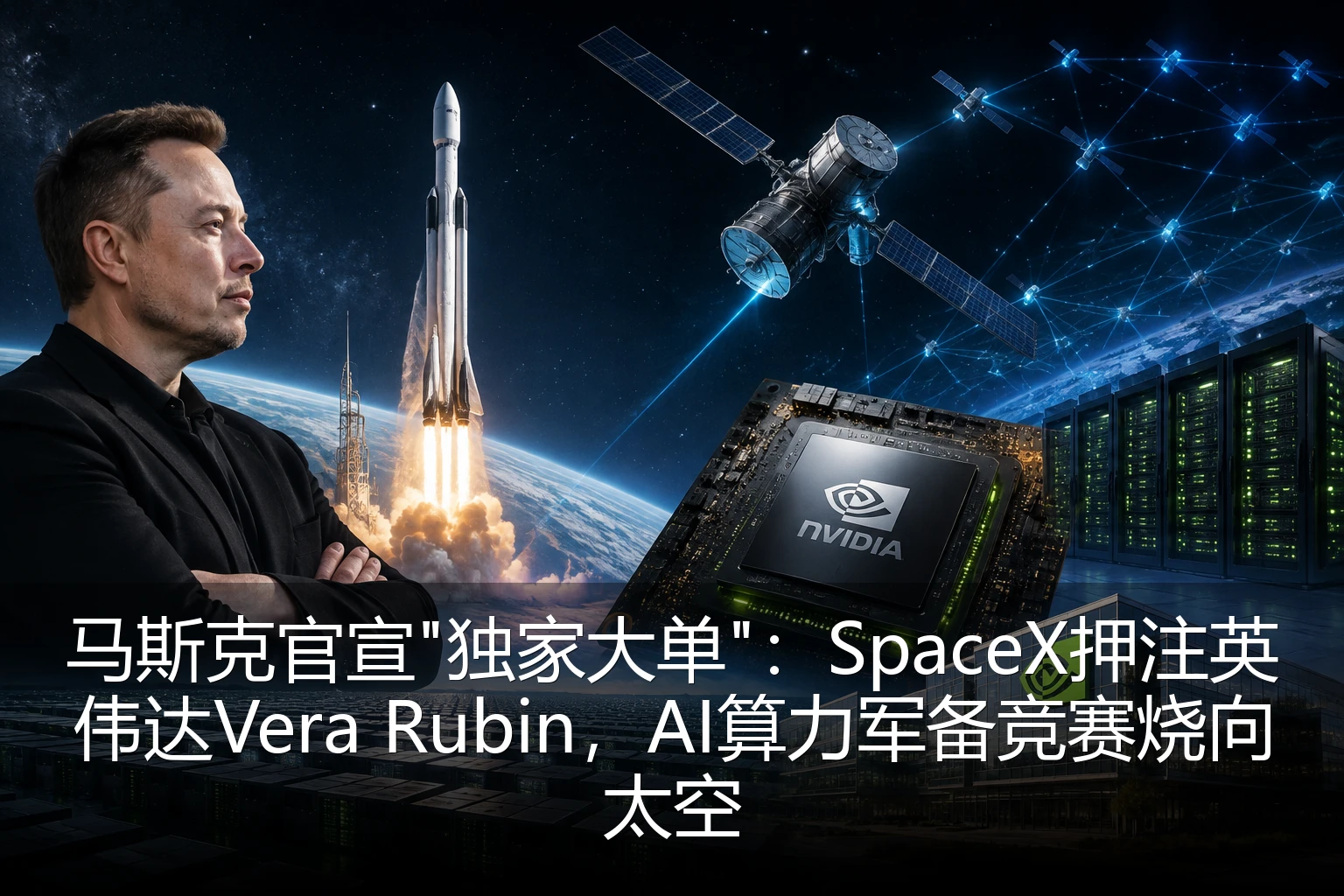
After the market close on August 4th, SpaceX released its first quarterly report since going public, but what really made Wall Street excited was the "heavy bomb" that Musk dropped in the earnings conference call: SpaceX's future all AI computing construction will exclusively use NVIDIA technology, and praised its Vera Rubin architecture as "currently the best AI computer." After the news, NVIDIA's stock price rose 3.4% the next day, achieving its fifth consecutive day of gains, with a cumulative increase of 15.4% over five days, reaching a two-month high; while AMD, which had been highly expected by the market, fell by more than 7%, and SpaceX's own stock price even plummeted 13.6%. A battle for dominance in AI computing power is burning from ground data centers to near-Earth orbit.
One, First Earnings Report Impressive, But Capital Expenditure Makes the Market Frown
As one of the world's highest-valued new listed companies, SpaceX's first quarterly report has naturally received much attention. The earnings report showed that SpaceX's total revenue in Q2 2026 reached $7.814 billion, a year-on-year increase of 92%, far exceeding analysts' expectations of $6.9 billion. Among them, the connectivity sector, mainly led by Starlink business, contributed $4.29 billion in revenue, a 66% year-on-year increase, remaining the company's current most important revenue source and the only profitable business segment; the highly watched AI business revenue reached $2.56 billion, a year-on-year surge of 247%, while operating losses narrowed by 49% to $1.3 billion.
However, the beautiful revenue numbers were overshadowed by the rapidly expanding capital expenditure. SpaceX's capital expenditure this quarter reached a staggering $18.37 billion, more than six times that of the same period last year, of which investment in the AI field reached $15.83 billion, a year-on-year surge of 2013%. Coupled with the selling pressure from the impending unlock of the first batch of IPO restricted shares, SpaceX's stock price fell about 8% after the earnings report, with a market value evaporating by about $130 billion in one night. The core concern in the market is: when will such massive AI investment achieve a profit闭环?
Two, Why is an "Exclusive" Order Worth Billions?
Musk's answer is deep integration with NVIDIA. He clearly stated that SpaceX has decided to exclusively use NVIDIA technology in AI computing construction, and revealed that the company plans to deploy NVIDIA's Vera Rubin NVL72 rack-level systems simultaneously on the ground and in space. The two parties are also jointly developing the Starmind AI1 satellite computing payload - each Starmind satellite will be equipped with NVIDIA Rubin GPU and Vera CPU, with peak computing power increased to 250 kilowatts, equivalent to directly putting data center-level computing power into near-Earth orbit, with the first batch of satellites expected to launch next year.
The commercial weight of this "exclusive" commitment is not to be underestimated. Musk revealed in the conference call that SpaceX expects to build more than 2 gigawatts (GW) of computing capacity by the end of 2026, and approach 10 GW by the end of 2027. Meanwhile, NVIDIA CEO Jensen Huang has given a key calculation: every 1 GW of computing power can create about $40-50 billion in revenue for NVIDIA. In other words, the planned computing expansion by SpaceX alone in the next two years could bring potential orders of hundreds of billions of dollars for NVIDIA - this is a conservative estimate beyond incremental demand such as Starmind satellites and cloud service agreements. It is precisely for this reason that the market interpreted this news as a major demand benefit for NVIDIA, with capital quickly returning from the chip sector's correction panic to the most performance-determining computing leader.
Three, Industry Interpretation: The "Open Conspiracy" of Full-stack Vertical Integration
In fact, SpaceX's "exclusive" choice is not accidental, but the inevitable result of NVIDIA's full-stack strategy in recent years. Just this week, NVIDIA announced that the Vera CPU has officially entered mass production and delivery - this self-developed CPU, together with GPU and network interconnection, forms a "trinity" complete solution, marking NVIDIA's leap from "GPU supplier" to "full-stack computing factory definer." In the past, a cloud vendor building an AI cluster needed to separately purchase CPUs from Intel or AMD, GPUs from NVIDIA, network chips from Broadcom, and then complete system integration themselves; now, NVIDIA provides a ready-to-use whole cabinet solution, customers only need to connect power and cooling to operate.
The performance and power advantages brought by this deep coupling are precisely the confidence behind Musk's "best" claim. The Vera Rubin platform has been fully mass-produced since GTC 2026, integrating seven new chips and covering five rack systems, with its throughput per megawatt increasing by about 10 times compared to the previous generation Grace Blackwell NVL72 - directly addressing the core pain point of power-constrained AI factories. For leading model companies like OpenAI and Anthropic, choosing NVIDIA's full-stack solution is the most efficient choice, and now SpaceX's addition further validates the attractiveness of this approach in the large customer group.
In contrast, AMD's situation is slightly embarrassing. Although its data center business revenue doubled to $6.72 billion in Q2 and Q3 guidance also exceeded expectations, after SpaceX announced exclusive use of NVIDIA technology, the market began to worry about potential order loss risks in its competition for large customers. Analysts point out that what customers are switching is no longer just a chip, but the entire infrastructure architecture, and the migration cost is high enough to make most enterprises give up the idea - NVIDIA is using systematic competition to push competitors out of key customer lists.
Four, The Second Half of the Computing Arms Race: From Ground to Space
Zooming out, SpaceX's partnership with NVIDIA is just a microcosm of the global AI computing arms race. The just-ended earnings season showed that the four major tech giants Microsoft, Amazon, Google, and Meta have a combined capital expenditure approaching $750 billion in 2026, with no signs of slowing down the new round of computing expansion. Google raised its full-year capital expenditure guidance to $195-205 billion, Amazon raised it to $220 billion, and Meta raised its lower limit to $130 billion. But at the same time, free cash flow is under全面 pressure: Amazon fell to -$7.6 billion, Google turned negative for the first time since listing to -$5.9 billion, and Meta's free cash flow plummeted 91%.
Market worries about "heavy investment in computing, returns to be verified" are intensifying, and stock price differentiation is increasingly obvious: Microsoft, which has a cloud business monetization closure, rose 15.5% after earnings, while Meta, which mainly relies on advertising monetization, suffered a heavy setback. SpaceX's choice to build its AI services "exclusively" on NVIDIA's system and claim that annualized revenue will reach $100 billion by December and $1 trillion by 2030 is essentially betting on a bigger story - turning computing power itself into rentable "digital real estate," and using satellite networks to deliver computing power to any corner of the Earth.
Five, Investor Perspective: Certainty Premium and Bubble Risk Coexist
For US stock investors, the enlightenment from this hot event is multi-layered:
- Certainty premium is concentrated on computing leaders. Against the background of sustained high capital expenditure from global cloud vendors and tech giants, the GPU order-full, supply-short situation is difficult to reverse in the short term, and NVIDIA, as the "shovel seller," still has the highest visibility of performance, and SpaceX's exclusive order further strengthens its long-term revenue expectations.
- The industry chain has new narrative support points. SpaceX's Starmind plan extends AI computing to space, driving up satellite computing payloads, optical interconnection, rack-level systems and other细分 directions, and the valuation elasticity of related supply chain companies is worth attention.
- Be alert to cash flow black holes and unlock selling pressure. SpaceX's single-quarter AI capital expenditure exceeds its own revenue, and with restricted shares about to unlock, the market has begun to question the "AI input-output ratio." Historically, when computing investment speed far exceeds commercialization realization speed, stock price volatility is often unavoidable - the recent pullback of AMD, SanDisk and other stocks is a lesson.
- Full-stack trend reshapes competitive landscape. NVIDIA's CPU+GPU+network integrated solution is shaking the decades-old horizontal division system of the x86 camp, and the value chains of Intel, AMD, and traditional server manufacturers may be re-priced, and investors need to pay attention to the long-term impact of this structural change on the semiconductor sector.
Overall, the "exclusive marriage" between SpaceX and NVIDIA is both a landmark event of AI computing demand moving from cloud to space and a clear signal that the computing arms race has entered the second half. When capital expenditure moves from the billions to the trillions level, whoever can fastest convert computing power into revenue will gain the advantage in the next round of valuation re-estimation. For ordinary investors, instead of chasing short-term news-driven pulse trading, it is better to grasp the core assets with the strongest certainty along the main line of "computing demand - capital expenditure - commercialization realization."