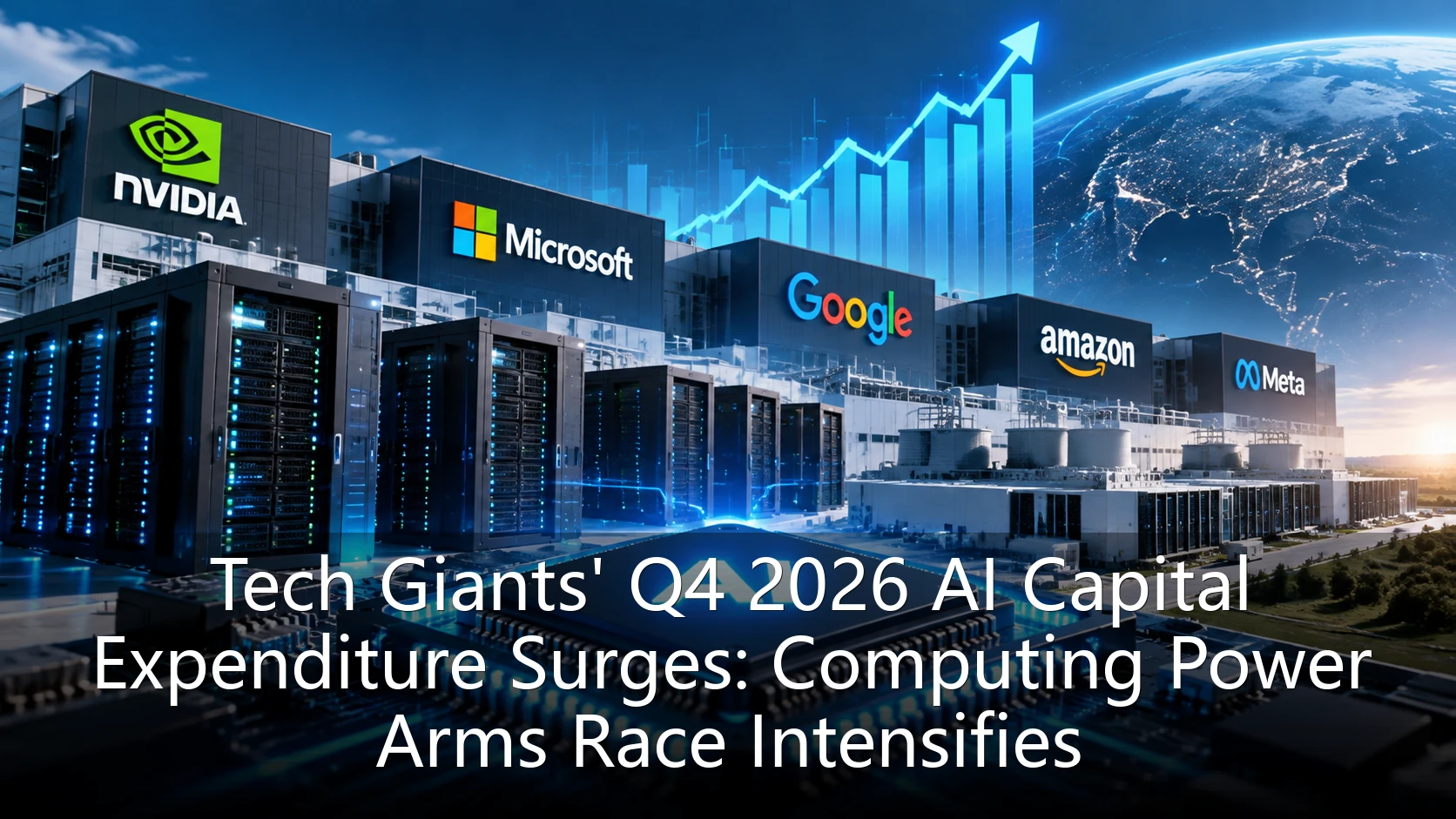
Tech Giants' Q4 2026 AI Capital Expenditure Surges: Computing Power Arms Race Intensifies
\n\nWith the rapid development of artificial intelligence technology, global tech giants are launching an unprecedented computing power arms race. In Q4 2026, multiple US tech giants have increased their capital expenditure in the AI field, a trend that not only reflects enterprises' emphasis on AI technology but also indicates that the global AI computing power market will usher in a new peak of growth.
\n\nTech Giants' AI Capital Expenditure Continues to Climb
\n\nAccording to the latest financial reports, in Q4 2026, US tech giants' capital expenditure on AI infrastructure increased by over 50% year-on-year. This growth is mainly driven by continued investments from major companies in high-performance AI chips, data center construction, and cloud computing services. Tech giants represented by Microsoft, Google, Amazon, and Meta are deploying AI computing power infrastructure with unprecedented strength to meet the growing demands of AI model training and inference.
\n\nMicrosoft CEO Satya Nadella stated in the recent earnings conference call: "AI is reshaping our business model, and we will invest over $100 billion in AI infrastructure over the next five years, including data centers, high-performance computing clusters, and specialized AI chips." This statement clearly demonstrates Microsoft's strategic determination in the AI field.
\n\nAnalysis of AI Computing Power Market Competition Landscape
\n\nCurrently, the AI computing power market exhibits a "Matthew effect" where the strong get stronger. NVIDIA dominates the AI training field with its GPU architecture, while AMD and Intel are accelerating their catch-up. Tech giants like Google, Amazon, and Microsoft are reducing their dependence on third-party suppliers through self-developed chips and specialized AI processors.
\n\nMarket research institutions predict that by the end of 2026, the global AI chip market size will exceed $200 billion, with a compound annual growth rate of over 35%. In this rapidly growing market, self-developed chips from NVIDIA, AMD, Google's TPU, Amazon's Inferentia, etc., will form a new competitive landscape.
\n\nMultiple Driving Factors for AI Computing Power Demand Growth
\n\nThe surge in AI computing power demand mainly comes from the following factors:
\n\n- \n
- Large Model Training Demand: With the iterative upgrades of large models like GPT-5 and Claude-3, training these models requires unprecedented computing resources. Taking GPT-5 as an example, its training computing power demand is more than 10 times that of GPT-3. \n
- AI Application Scenario Expansion: From autonomous driving to medical diagnosis, from financial risk control to smart manufacturing, AI application scenarios are rapidly expanding, each requiring substantial computing power support. \n
- Real-time Inference Demand: As AI applications migrate from the cloud to edge devices, the demand for low-latency, high-efficiency AI inference is growing rapidly, driving the development of specialized AI chips. \n
- Rise of Multimodal AI: AI models capable of processing text, images, audio, and other modalities require more powerful computing capabilities, further driving computing power demand. \n
Challenges and Opportunities in AI Computing Power Investment
\n\nAlthough the AI computing power market has broad prospects, investors also face numerous challenges:
\n\n- \n
- Technology Iteration Risk: AI chip technology is updating at an extremely fast pace, requiring investors to closely follow technological development trends to avoid investing in outdated technologies. \n
- Supply Chain Risk: The production of high-end AI chips highly depends on advanced process technologies, and supply chain stability poses challenges to investors. \n
- Policy and Regulatory Risk: With the widespread application of AI technology, governments worldwide are increasingly regulating AI technology, which may affect the business strategies of related companies. \n
- Valuation Risk: AI computing power concept stocks are generally highly valued, and investors need to be alert to valuation bubble risks. \n
However, challenges also bring significant opportunities:
\n\n- \n
- Industry Chain Investment Opportunities: From chip design and manufacturing to data center construction and cloud computing services, all links in the AI computing power industry chain offer investment opportunities. \n
- Vertical Field Applications: AI applications in vertical fields such as healthcare, finance, and manufacturing are deepening, and these fields have more certain growth in AI computing power demand. \n
- Emerging Technology Integration: The integration of emerging technologies like quantum computing and neuromorphic computing with AI may bring disruptive computing power improvements. \n
Future Outlook and Investment Recommendations
\n\nLooking ahead, the AI computing power market will show the following development trends:
\n\n- \n
- Specialization and Customization: Specialized AI chips for specific application scenarios will experience rapid development, and the general GPU market will face challenges. \n
- Energy Efficiency Ratio Becomes Key Indicator: With increasing environmental requirements, the energy efficiency ratio of AI chips will become an important metric for measuring performance. \n
- Rise of Edge Computing: With the popularization of 5G and IoT, edge AI computing will experience explosive growth. \n
- Open Source Ecosystem Competition: The open sourcing of AI frameworks and toolchains will become a trend, and competition among enterprises will focus more on hardware and optimization capabilities. \n
For investors, the following strategies are recommended:
\n\n- \n
- Focus on Core Suppliers: Core AI chip suppliers like NVIDIA and AMD will continue to benefit from industry growth. \n
- Layout Industry Chain Upstream and Downstream: Pay attention to investment opportunities in all aspects of the AI chip industry chain, including design, manufacturing, packaging and testing, and data center construction. \n
- Focus on Vertical Field Applications: Applications in vertical fields like medical AI and financial AI will bring certain computing power demand growth. \n
- Diversify Investments to Reduce Risk: The AI computing power market is highly volatile, and investors are advised to diversify their investments to reduce risks associated with single positions. \n
Conclusion
\n\nIn Q4 2026, the surge in capital expenditure by tech giants in the AI computing power field marks the comprehensive escalation of the AI computing power arms race. With the growth of large model training demands, expansion of AI application scenarios, and increasing real-time inference needs, the AI computing power market will maintain high-speed growth. However, investors also need to pay attention to risks related to technology iteration, supply chains, policy regulation, and valuation. By seizing opportunities in the AI computing power market while adopting reasonable investment strategies, investors can achieve substantial returns in this wave of AI development.
\n\nIn the future, AI computing power technology will develop in the direction of higher efficiency, greater specialization, and better energy conservation. Those companies that can continuously innovate and meet market demands will stand out in the fierce competition and create long-term value for investors.