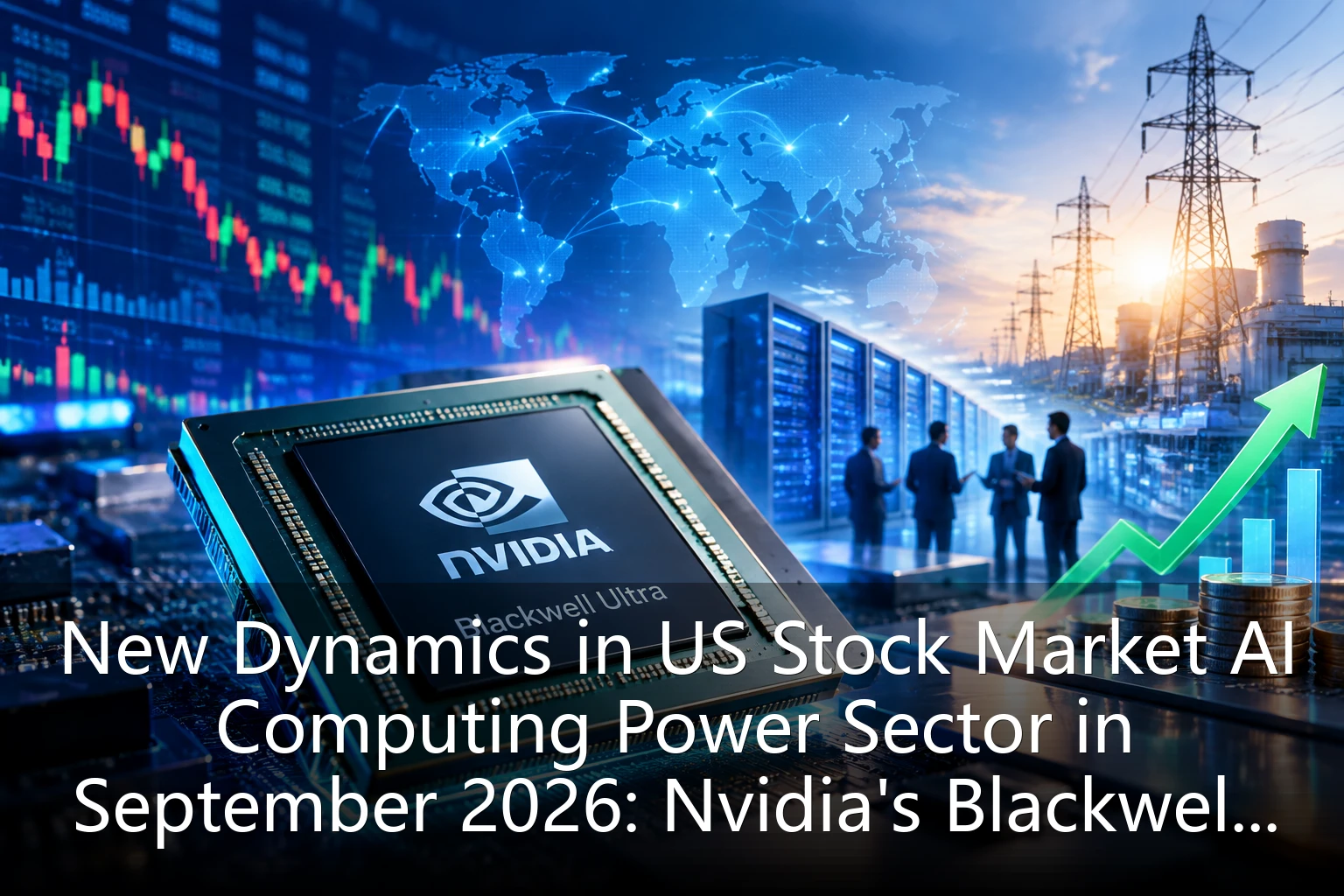
New Dynamics in US Stock Market AI Computing Power Sector in September 2026: Nvidia's Blackwell Ultra Delay Triggers Industrial Chain Restructuring and Investment Opportunities
With the rapid development of artificial intelligence technology, the AI computing power market has become a focal point of global technological competition. In the third quarter of 2026, the US stock market AI computing power sector has witnessed a series of significant changes, particularly the delayed shipment of Nvidia's Blackwell Ultra chips, which has not only triggered market fluctuations but also accelerated the restructuring of the entire industrial chain. This article will provide an in-depth analysis of the latest developments in the current US stock market AI computing power sector, explore strategic adjustments by tech giants, and offer forward-looking perspectives for investors.
Nvidia's Blackwell Ultra Delayed Shipment, Market Reacts Sharply
In early September 2026, Nvidia (NVDA), the world's largest AI chip manufacturer, announced that the mass production timeline for its latest-generation Blackwell Ultra chip (B300) would be postponed to the first quarter of 2027, a delay of approximately 3 months from the original plan. This news caused sharp fluctuations in the US stock market AI computing power sector, with Nvidia's stock price falling by more than 8% in a single day, and related supply chain companies such as Broadcom (AVGO), AMD (AMD), etc., also experiencing varying degrees of decline.
As the absolute leader in AI computing power chips, Nvidia's product supply directly affects the rhythm of the entire AI industrial chain. Blackwell Ultra, as Nvidia's most advanced AI computing platform, was originally scheduled for large-scale shipments in the fourth quarter of 2026 to support next-generation large model training and inference needs. This delay in shipment is mainly due to yield rate issues in advanced process technology and challenges in packaging technology, reflecting that high-end AI chip manufacturing is facing unprecedented technical bottlenecks.
Supply Chain Companies' Stock Price Fluctuations, Market Re-evaluates AI Computing Power Demand
The news of Nvidia's Blackwell Ultra delay not only affects chip manufacturers but also impacts the entire AI computing power industrial chain. From server manufacturers such as Supermicro (SMCI), Dell (DELL), to data center service providers such as Digital Realty (DLR), Equinix (EQIX), to cloud service providers such as Amazon (AMZN), Microsoft (MSFT) and Google (GOOGL), all have been affected to varying degrees.
However, it is worth noting that after short-term fluctuations, the market has begun to re-evaluate the true strength of AI computing power demand. Multiple Wall Street analysts pointed out that although high-end chip supply is delayed, enterprise-level AI application demand remains strong, especially in the inference service sector. This change in demand structure is driving the AI computing power industrial chain toward diversified development, shifting from relying solely on high-end training chips to a balanced layout that emphasizes both training and inference.
Tech Giants Accelerate Layout of AI Computing Power Diversification Strategy
Facing the market uncertainty caused by Nvidia's Blackwell Ultra delay, major tech giants are adjusting their AI computing power strategies and accelerating the construction of diversified computing power ecosystems.
Microsoft: Self-developed Chips and External Procurement Working in Parallel
As the world's second-largest cloud service provider, Microsoft is accelerating its self-developed AI chip strategy. In August 2026, Microsoft officially released its next-generation AI training chip "Maia 2", which offers 40% performance improvement over the previous generation. At the same time, Microsoft is also actively expanding cooperation with chip manufacturers such as AMD and Intel (INTC) to reduce dependence on a single supplier. According to insiders, Microsoft plans to triple its AI computing power infrastructure within the next 18 months to meet the growing demand for AI services.
Google: TPU "Ironwood" Commercialized, Inference Cost Significantly Reduced
In September 2026, Google announced that its seventh-generation TPU "Ironwood" has been officially commercialized. This chip specially designed for AI inference can reduce inference costs by 90%, significantly enhancing the commercial viability of AI applications. Google CEO Sundar Pichai stated that the launch of Ironwood will make Google's AI services more competitive, especially in the large model inference sector. Meanwhile, Google is also establishing strategic partnerships with multiple chip manufacturers to ensure the stability of its AI computing power supply.
Amazon: Customized Chips and Open Source Ecology Equally Emphasized
Amazon Web Services (AWS), in the third quarter of 2026, launched its next-generation Trainium3 chip, designed for large-scale AI training. AWS also announced the expansion of its open source AI ecosystem, promoting the standardization and popularization of AI computing power through projects like OpenAccel. AWS CEO Andy Jassy emphasized that AWS's goal is to become "the most comprehensive and cost-effective AI cloud service platform," a strategic positioning that keeps it strongly competitive in the AI computing power market.
AI Computing Power Rental Market Rising, New Business Models Emerging
Beyond traditional computing power supply models, the AI computing power rental market is rapidly emerging. New computing power service providers represented by CoreWeave and Nscale are providing flexible and efficient AI computing power solutions for enterprises through innovative business models.
In September 2026, Nscale announced the completion of a new round of financing, with a valuation exceeding $10 billion. This company, founded just 3 years ago, has signed long-term computing power rental agreements with multiple enterprises, with a total value of $51 billion. The uniqueness of Nscale lies in its "computing power as a service" model, where customers can flexibly adjust their computing power usage based on actual needs, significantly lowering the threshold for enterprises to deploy AI applications.
Meanwhile, traditional data center operators such as Digital Realty and Equinix are also actively transforming, launching specialized AI computing power hosting services to provide customers with comprehensive solutions from chips to data centers. This business model innovation is reshaping the competitive landscape of the AI computing power market.
Power Bottlenecks Constrain AI Computing Power Expansion, Nuclear Energy Cooperation Becomes New Trend
With the explosive growth of AI computing power demand, the power supply for data centers has become a constraining factor. According to industry data, a large AI data center can consume more than 100 megawatts of electricity annually, equivalent to the power consumption of a small city. In multiple western US states, insufficient power supply has become a major obstacle to new data center construction.
To solve this problem, tech giants are beginning to seek deep cooperation with energy companies. In August 2026, Microsoft announced a 20-year power purchase agreement with nuclear energy company Kairos Power to provide clean energy for its AI data centers. This cooperation has created a new model between tech companies and the nuclear energy industry, and is expected to promote the emergence of more similar collaborations.
Meanwhile, innovative solutions such as liquid cooling technology and high-density server architectures are constantly emerging, aiming to increase computing power density per unit area and reduce energy consumption. These technological innovations will provide key support for the sustainable development of AI computing power.
AI Computing Power ETF Market Continues to Heat Up, Investment Opportunities Diversify
With the rapid development of the AI computing power market, related ETF products are also favored by investors. In the third quarter of 2026, multiple AI computing power ETFs saw record-high net capital inflows, reflecting the market's long-term optimism about the AI computing power sector.
Semiconductor ETFs: Focusing on AI Chip Leaders
Semiconductor ETFs represented by the VanEck Semiconductor ETF (SMH) continue to attract capital inflows. These ETFs mainly invest in leading AI chip companies such as Nvidia, AMD, and Broadcom, sharing in the growth dividends of AI computing power. Data shows that SMH had net capital inflows of over $5 billion in the third quarter of 2026, a record high.
Cloud Computing ETFs: Focusing on AI Service Providers
Cloud computing ETFs like the Global X Cloud Computing ETF (CLOUD) focus on cloud service giants such as Amazon, Microsoft, and Google. As enterprise AI applications migrate to the cloud, these companies have become the main beneficiaries of AI computing power demand. CLOUD achieved net capital inflows of $3 billion in the third quarter of 2026, showing strong performance.
Data Center ETFs: Positioning in Computing Power Infrastructure
Data center ETFs like the Digital Infrastructure ETF (TOWR) focus on data center operators and related infrastructure providers. With the growth of AI computing power demand, these companies are expected to achieve continuous and stable revenue growth. TOWR had net capital inflows of approximately $2 billion in the third quarter of 2026, showing investors' confidence in the data center sector.
Future Outlook for AI Computing Power Market: Challenges and Opportunities Coexist
Looking ahead, the US stock market AI computing power sector will face multiple challenges while also containing huge opportunities.
Technical Challenges: Balancing Advanced Processes and Energy Efficiency
As the scale of AI models continues to expand, the demand for computing power is growing exponentially. However, the development speed of advanced process technology is slowing down, and chip energy efficiency is facing bottlenecks. In the future, AI chip design needs to find a balance point between computing power, energy efficiency, and cost, which will be a key challenge for technological development.
Supply Chain Challenges: Balancing Globalization and Localization
The global AI chip supply chain is facing restructuring pressure. On one hand, technology-leading countries are strengthening export controls to limit the outflow of high-end chips; on the other hand, countries are increasing investment in domestic chip industries to seek supply chain security. This balance between globalization and localization will become an important trend in the future development of the AI computing power supply chain.
Market Opportunities: Emerging Application Scenarios Continuously Emerging
With the popularization of AI technology, emerging application scenarios are constantly emerging, bringing new growth points for the AI computing power market. Fields such as autonomous driving, medical AI, smart manufacturing, and fintech will continue to have growing demand for AI computing power, providing broad market space for related companies.
Investment Opportunities: Opportunities in All Links of the Industrial Chain
For investors, every link of the AI computing power industrial chain contains investment opportunities. Upstream chip design, midstream manufacturing and packaging, downstream applications and services, each link has quality enterprises worth paying attention to. Especially in the context of Nvidia's Blackwell Ultra delay, companies with technical substitution capabilities and diversified product layouts are expected to achieve excess returns.
Conclusion: Rationally View Short-term Fluctuations, Long-term Layout of AI Computing Power Track
Nvidia's Blackwell Ultra delayed shipment is a short-term fluctuation in the development process of the AI computing power market and should not change the judgment of the long-term growth trend of AI computing power. On the contrary, this event has accelerated the diversified development of the industrial chain, providing investors with opportunities to re-evaluate and layout.
For long-term investors, the AI computing power track is still one of the most growth-oriented directions in the technology sector. It is recommended that investors focus on leading companies with core technologies, diversified product layouts, and strong customer bases, while also paying attention to small and medium-sized enterprises with innovation capabilities and differentiated competitive advantages in the industrial chain.
In terms of investment strategy, a core-satellite strategy can be adopted, with AI computing power ETFs as the core allocation, supplemented by carefully selected individual stocks, to diversify risks while capturing the growth dividends of AI computing power. At the same time, it is necessary to closely follow key factors such as technological progress, policy changes, and market demand, and adjust investment strategies in a timely manner.
Overall, although the US stock market AI computing power sector in September 2026 faces short-term challenges, the long-term growth prospects remain bright. The industrial chain restructuring caused by Nvidia's Blackwell Ultra delay will bring new development opportunities for companies with forward-looking layouts and innovation capabilities. Investors should rationally view short-term fluctuations and grasp the long-term investment value of the AI computing power track.