
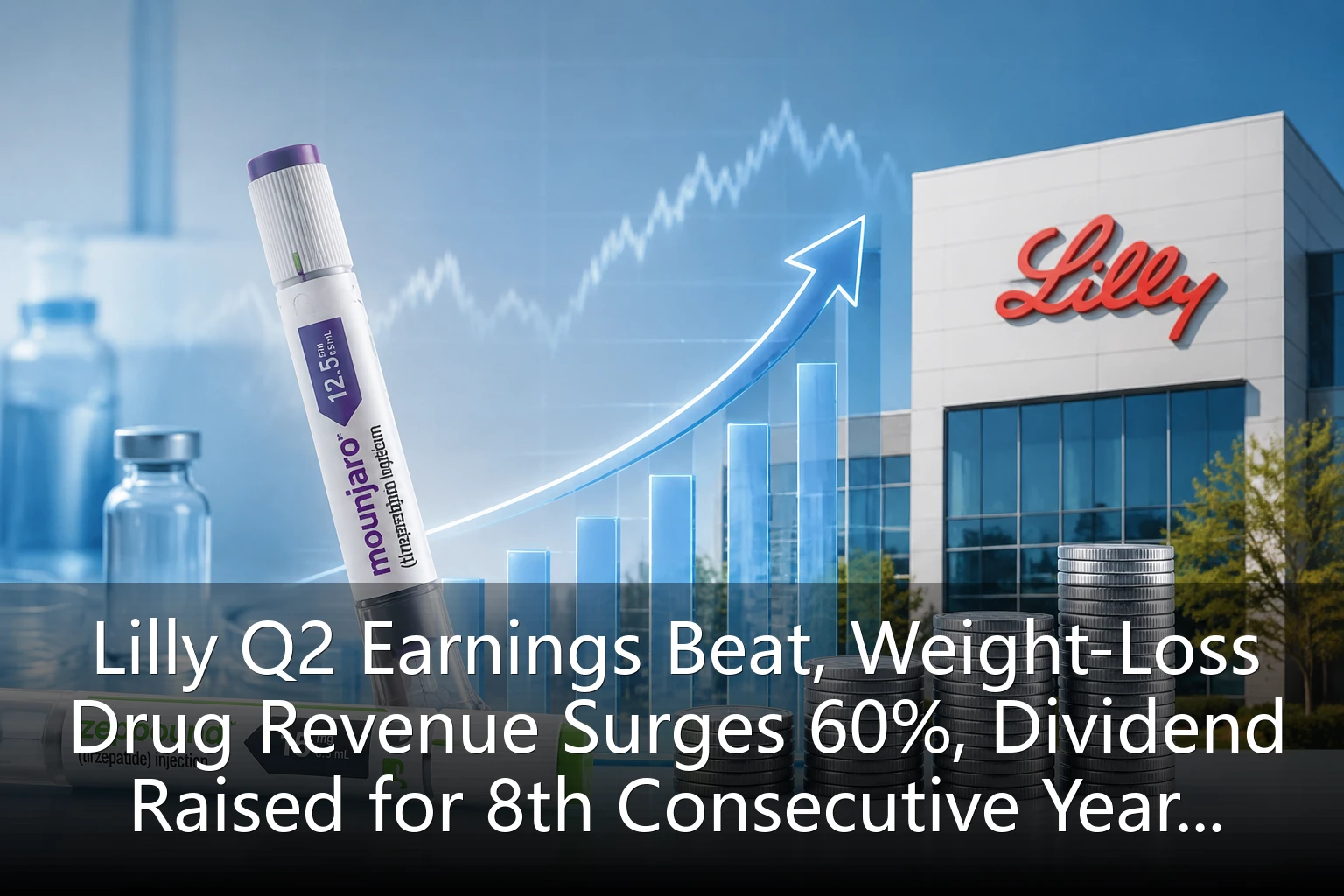
Comprehensive Earnings Beat, Weight-Loss Drug Duo Continues to Surge
On August 4, 2026, before the US market opened, global pharmaceutical giant Eli Lilly (ticker: LLY) reported its Q2 2026 earnings for the period ending June 30. Driven by sustained strong demand for GLP-1 weight-loss drugs, the company delivered impressive results: quarterly revenue reached $15.87 billion, up 36% year-over-year, surpassing the Wall Street consensus estimate of $15.2 billion; adjusted earnings per share (EPS) were $5.28, a 55% year-over-year surge, also significantly exceeding the expected $4.95.
Looking at the business breakdown, the weight-loss drug segment remains the undisputed growth engine. Core product Mounjaro (for type 2 diabetes) achieved sales of $6.2 billion, a 48% year-over-year increase; the weight-loss version, Zepbound, generated $3.1 billion in revenue, a staggering 72% surge. Together, they contributed $9.3 billion, accounting for 58.6% of total revenue.
Notably, against a backdrop where competitors like Novo Nordisk are accelerating capacity expansion, Eli Lilly's US market share for GLP-1 prescriptions remained stable above 55% this quarter, demonstrating strong brand loyalty and physician prescribing preference. During the earnings call, management specifically highlighted that positive clinical data for Zepbound in preventing diabetes and cardiovascular disease is prompting more primary care physicians to adopt it as a first-line weight management solution.
Capacity Bottleneck Breakthrough, Supply Constraints Significantly Eased
The capacity bottleneck that had plagued Eli Lilly for two years saw substantial improvement this quarter. The new manufacturing site in Concord, North Carolina, began full operations in April 2026, and the second-phase expansion at the Lebanon, Indiana plant was completed ahead of schedule. The company's CFO revealed during the call that GLP-1 production capacity has increased by approximately 80% compared to the same period last year, and all doses of Zepbound have been removed from the FDA's drug shortage list.
The direct effect of this capacity release is improved cost efficiency. Gross margin for the quarter reached 84.2%, up 1.3 percentage points sequentially. As capacity utilization further improves, management expects gross margin to continue trending upward to over 85% in the second half of the year. This trend is crucial for investors assessing Eli Lilly's long-term profitability, as some analysts previously worried that supply bottlenecks would allow generic drug makers or compounding pharmacies to seize market share.
Meanwhile, the company also completed the acquisition of a peptide active pharmaceutical ingredient manufacturer this quarter, further integrating its supply chain backward. This $750 million deal is expected to save the company approximately $200 million annually in raw material costs, with the full impact realized starting in 2027.
8th Consecutive Year of Dividend Increase, High Growth Can Also Offer "Dividends"
Alongside the stellar earnings, Eli Lilly's board approved the latest dividend increase plan. The quarterly dividend was raised from $1.50 to $1.62 per share, an 8% increase. This marks the 8th consecutive year Eli Lilly has raised its dividend since 2019, fully reflecting management's confidence in sustained free cash flow growth.
Based on the latest stock price, Eli Lilly's current dividend yield is approximately 0.6%. While this absolute figure is not high among traditional dividend stocks, combined with the company's stock price appreciation in recent years, its total return capability far exceeds most high-dividend-yield targets. Since the beginning of 2023, Eli Lilly's stock price has cumulatively risen over 280%, compared to a roughly 35% increase for the S&P 500 Pharmaceutical Index over the same period.
This combination of "high growth + sustained dividend increases" is precisely the investment logic consistently advocated by the US Dividend Pharma column. For investors seeking long-term compound returns, pharmaceutical leaders like Eli Lilly, which possess both earnings explosiveness and dividend discipline, offer a more attractive option than pure high-dividend stocks. Especially against the current backdrop of high valuations in the AI computing sector and increased market volatility, the defensive attributes of dividend pharma stocks, combined with their growth potential, appear particularly valuable.
Pipeline Progress Shines, AI Accelerates New Drug R&D
Beyond the strong performance of existing products, Eli Lilly's pipeline also delivered multiple positive updates. This quarter, the company's oral GLP-1 drug, Orforglipron, met its primary endpoint in Phase III clinical trials, with data showing weight-loss efficacy comparable to injectable forms and milder gastrointestinal side effects. Eli Lilly plans to submit a New Drug Application to the US FDA by the end of 2026, positioning this product to potentially become the world's first approved oral GLP-1 weight-loss drug.
In the Alzheimer's disease space, another highly anticipated candidate, Remternetug (a next-generation amyloid antibody), also received accelerated approval acceptance from the FDA. Analysts estimate that if progress remains smooth, the drug could launch in the first half of 2027 and challenge the market position of Leqembi, previously approved by Eisai and Biogen.
It is worth emphasizing that Eli Lilly's investment in AI-assisted drug discovery is rapidly translating into productivity. The company disclosed this quarter that its AI drug discovery platform, in collaboration with Recursion Pharmaceuticals, has successfully advanced a novel small molecule candidate into Phase I clinical trials, taking only 18 months from target identification to human testing—far below the industry average of 4-5 years. This breakthrough not only reduces R&D costs but also significantly shortens the drug development cycle, providing greater certainty for Eli Lilly's future growth.
Market Reaction and Valuation Analysis
Following the earnings release, Eli Lilly's stock price rose over 4% in pre-market trading, breaking through the $950 mark. However, due to overall weakness in the broader US market that day, with the Nasdaq index dragged down by a pullback in the AI computing sector, falling about 1.2%, Eli Lilly ultimately closed up 2.8% at $938.
From a valuation perspective, Eli Lilly's current stock price corresponds to a forward price-to-earnings ratio (Forward PE) of approximately 42x, significantly higher than the S&P 500 pharmaceutical sector average of 18x. However, proponents argue that this valuation premium is justified considering the company's expected annualized earnings growth rate of over 25% over the next 3-5 years. More importantly, as GLP-1 drugs expand from simple weight loss to indications like cardiovascular protection, sleep apnea, and non-alcoholic fatty liver disease, the potential market space could expand from the current $100 billion scale to over $300 billion.
Nevertheless, investors should also be aware of several potential risk points. First is policy risk: the US Congress's investigation into the high pricing of GLP-1 drugs is ongoing, and if future price caps are introduced, they could erode Eli Lilly's profit margins. Second is competitive risk: Novo Nordisk's oral semaglutide has already been approved, and giants like Roche and Pfizer are also accelerating their layout in the weight-loss drug track. Finally, there is patent risk: patents for some of Eli Lilly's core products will expire in the early 2030s, and the impact of generics needs to be addressed proactively.
Investment Insights from Dividend Pharma
Eli Lilly's performance this quarter provides new footnotes for the investment logic of US Dividend Pharma. In the current market environment, investors face a dilemma: high-growth tech stocks have elevated valuations and are highly volatile, while traditional high-dividend stocks suffer from sluggish growth and struggle to hedge against inflation. Leading companies in the pharmaceutical sector, especially those possessing both innovative pipeline-driven growth and stable dividend policies, precisely fill this gap.
From a portfolio construction perspective, we suggest investors consider the following approaches: first, use pharmaceutical stocks like Eli Lilly, Novo Nordisk, Johnson & Johnson, and Merck, which combine growth and dividend attributes, as core holdings; second, gain overall sector exposure through healthcare ETFs (such as XLV, VHT) to reduce single-stock volatility risk; third, pay attention to investment opportunities in the AI pharmaceutical field, such as companies like Recursion and Schrödinger, which, while not directly paying dividends, represent the future direction of the pharmaceutical industry's productivity revolution.
With a flawless earnings report, Eli Lilly has once again proven that the innovation dividend in the pharmaceutical industry is far from over. As weight-loss drugs upgrade from "lifestyle medications" to "cornerstones of chronic disease management," and as AI moves from "concept hype" to a "R&D accelerator," dividend pharma stocks are writing their own growth story. For investors pursuing long-term compound returns, this may be the best of times.


