
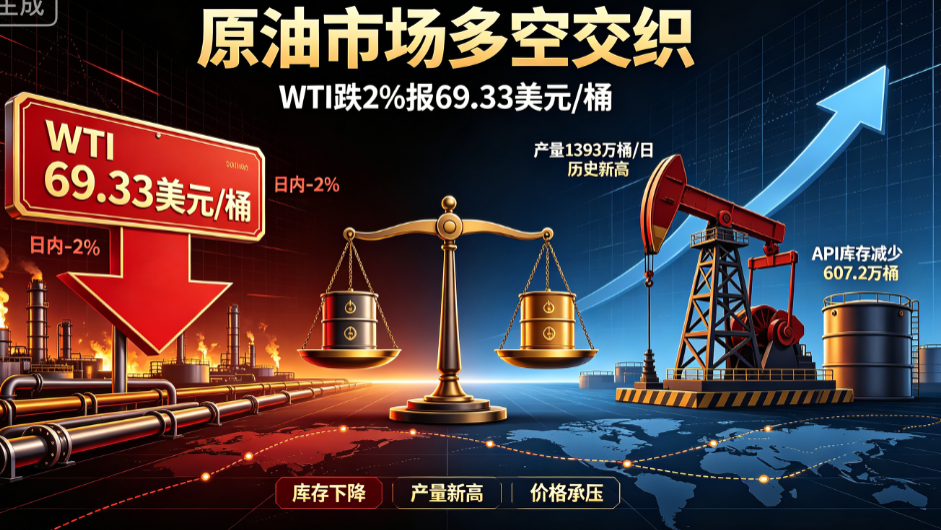
Supply-Demand Game Intensifies: WTI Crude Under Pressure, Inventory and Production Data Send Contradictory Signals
Recently, the international crude oil market has seen significant volatility. WTI crude fell 2% intraday to close at $69.33 per barrel, while the latest data from the American Petroleum Institute (API) showed that for the week ending June 26, US crude inventories fell by 6.072 million barrels, yet US crude production rose to 13.93 million barrels per day, a record high. This seemingly contradictory set of data reflects profound changes and complex games in the current global crude oil supply-demand pattern. This article will analyze the logic behind this phenomenon and its potential impact on future oil price trends from multiple dimensions: inventory plunge, production surge, demand outlook, and OPEC+ policy.
1. Inventory Plunge and Production Surge: Seemingly Opposite, Actually Unified Market Signals
API inventory data showed that crude inventories fell by a larger-than-expected 6.072 million barrels for the week, far exceeding market expectations for a decline. Typically, a significant drop in inventories is seen as a sign of strong demand or tight supply, theoretically supporting oil prices. However, oil prices fell instead of rising because of another set of data: US crude production rose to 13.93 million bpd, a record high. This sharp increase in production means the supply side is accelerating release, offsetting some of the positive impact of the inventory decline.
More notably, the inventory decline itself may not be entirely demand-driven. Recently, US refinery utilization rates have remained high, with processing volumes up, causing crude inventories to shift to refined products. Additionally, some of the inventory decline may be due to higher exports. Therefore, the two data points – inventory draw and production rise – are superficially contradictory but actually point to a core logic: US shale oil producers are ramping up output driven by high oil prices, while the growth momentum of global demand is beginning to weaken. This pattern of "strong supply, weak demand" is precisely the root cause of oil prices under pressure.
2. Structural Dynamics Behind Production Record: Shale Tech Innovation and Capital Expenditure Return
US crude production exceeding 13.93 million bpd not only surpasses the pre-pandemic peak in early 2020 but also reveals a structural transformation in the US oil industry. First, continuous improvements in horizontal drilling and hydraulic fracturing technology have significantly increased initial production (IP) per well while lowering per-well costs. This means producers can obtain more crude with the same capital investment. Second, after a low capex cycle in 2020-2021, major US shale oil companies have gradually increased exploration and development budgets since 2022. Abundant cash flow from high oil prices has prompted companies to reinvest more profits into capacity expansion.
However, this production growth is not without concerns. Labor shortages, equipment supply chain bottlenecks, and ESG pressures still exist in the US shale industry. Moreover, most listed companies still prioritize shareholder returns (such as stock buybacks and dividends) over aggressive expansion. Therefore, breaking the current production record is more the result of efficiency gains and activity by some private companies than full-scale industry expansion. This also means that the room for further significant production increases may be limited in the future.
3. Demand Outlook Clouded: Dual Pressures of Global Economic Slowdown and Energy Transition
In contrast to supply side hitting new highs, the global crude oil demand outlook faces increasing uncertainty. Institutions such as the IMF and World Bank have recently downgraded global economic growth expectations, especially as the pace of recovery in Europe and China is slower than expected. Manufacturing PMI data remains weak, and jet fuel demand, though recovering, has not fully returned to pre-pandemic levels. More importantly, major central banks are still maintaining high interest rate environments to combat stubborn inflation, further dampening economic activity and commodity consumption.
Another layer of pressure comes from energy transition. Although fossil fuels remain irreplaceable in the short term, policies supporting renewable energy and electric vehicles are accelerating globally. The penetration of EVs in China and Europe is rising rapidly, directly compressing the growth space for gasoline demand. In the medium to long term, the global peak oil demand may arrive earlier than expected. This structural change is reshaping market expectations, making investors less confident in long-term high oil prices.
4. OPEC+'s Policy Choice: Production Cuts to Support Market vs. Market Share Battle
Facing continued rising US production and weak demand, the OPEC+ alliance faces a difficult balance. Previously, OPEC+ announced extending voluntary production cuts to the end of 2024, but actual compliance varies. Core members like Saudi Arabia strictly adhere to quotas, while countries like Iraq and Kazakhstan have repeatedly overproduced. The news of US record production raised market concerns that OPEC+ may be forced to adopt more aggressive cuts to stabilize prices. However, further cuts would mean ceding more market share to the US and other non-OPEC producers.
Additionally, geopolitical factors within OPEC+ increase the difficulty of policy coordination. Although Saudi Arabia and Russia cooperate on cuts, their national strategic interests are not fully aligned. Russia, under Western sanctions, needs stable oil revenue to support its fiscal budget, while Saudi Arabia focuses more on maintaining long-term market influence. This delicate game makes future OPEC+ production decisions highly uncertain.
5. Short-Term Outlook: Oil Prices Likely to Oscillate in a Range, but Downside Risk Increasing
Based on the above analysis, WTI crude prices are likely to oscillate in a range of $68-75 per barrel in the short term. Supporting factors include: supply rigidity from OPEC+ cuts, US Strategic Petroleum Reserve (SPR) replenishment demand, and summer driving season boost to gasoline consumption. However, suppressing factors are also evident: supply increases from US record production, demand concerns from weak global economic data, and a strong dollar index due to hawkish Fed stance.
Special caution is needed: if US EIA crude inventories accumulate for consecutive weeks in the future, or if Chinese economic data misses expectations, oil prices may break below the key support level of $68, potentially testing the low of $65. Conversely, if geopolitical tensions in the Middle East escalate suddenly (such as a deadlock in the Iran nuclear issue) or OPEC+ sends stronger cut signals, oil prices may briefly spike above $75. Overall, volatility in the oil market will remain high, and investors should closely watch weekly inventory reports and marginal changes in macroeconomic indicators.
Conclusion
The 2% intraday drop in WTI crude and the record high US crude production are not isolated events, but a microcosm of the profound transformation of the global energy market. The seemingly contradictory data of inventory plunge and production surge is actually a normal pain in the supply-demand rebalancing process. For market participants, understanding the technology and capital logic driving production growth, recognizing structural weakness in demand, and closely following OPEC+ policy dynamics will be key to grasping future oil price trends. In this era of great energy change, interpreting single data points can be misleading; only by examining the interaction of supply and demand from a systemic perspective can one navigate short-term market fog and capture true trend signals.


